

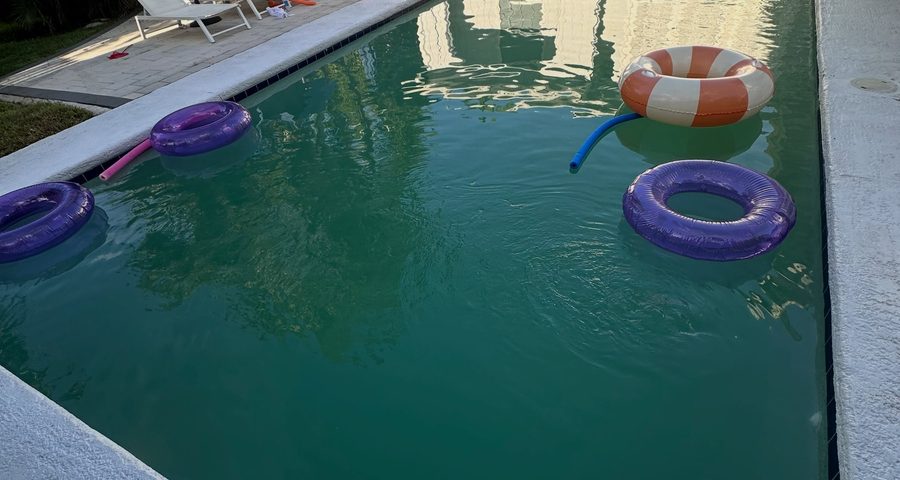
Why your pool turns green after a Florida storm
What actually happens to pool water during a Treasure Coast downpour, how fast algae takes hold, and the order we work in to bring a green pool back to clear.
A summer storm on the Treasure Coast does three things to a pool at once, and all three point the same way: towards algae.
What the rain actually does
First it dilutes. Two or three inches of rain in an afternoon drops your free chlorine, your stabiliser and your alkalinity together — the pool has more water in it, and the same amount of chemistry spread thinner.
Second it delivers. Runoff off the deck, the roof and the yard carries dirt, fertiliser, pollen and leaf litter into the water. All of that is organic load, and every bit of it consumes chlorine.
Third it takes the power out. If the pump stops, circulation stops, and water that is not moving through a filter is water that algae can settle in.
How fast it happens
In July, with water in the high eighties, a pool that has lost its chlorine can go from clear to cloudy overnight and from cloudy to green within two or three days. That is not neglect — that is Florida. The mistake people make is waiting to see whether it clears on its own. It does not.
The order we work in
- Test first. Free chlorine, pH, alkalinity, stabiliser. There is no point dosing blind, and a pool with sky-high stabiliser will not respond to normal chlorine levels at all.
- Get the debris out. Net the surface and the floor. Anything organic left in the pool eats the chlorine you are about to add.
- Brush everything. Walls, steps, behind the ladder, the shady corner where it always starts. Algae that is attached is protected; algae in suspension is easy to kill.
- Clean the filter. A blocked filter is the reason a lot of green pools stay green — you can dose all you like, but the dead algae has to come out somewhere.
- Then shock, and keep it there. One dose is rarely enough. The level has to stay up until the demand stops, which usually means testing and topping up daily for a few days.
- Run the pump hard. Twenty-four hours a day while it clears, not eight.
- Vacuum the dead algae to waste. Once the water goes from green to cloudy grey, the algae is dead and sitting on the floor. It goes out of the pool, not back through the filter.
When chemicals are not the answer
If the stabiliser level is very high, chlorine simply stops working properly and no amount of shock fixes it — the only cure is diluting the water. If the plaster is stained, or the algae is black algae rooted in the surface, you are looking at a drain and acid wash rather than a chemical recovery. We would rather tell you that on day one than take three weeks of your money first.
Preventing the next one
Keep stabiliser in range so your chlorine works, run the pump long enough to turn the water over, brush weekly, and keep the pool on service through the summer even if nobody is swimming. The pools that go green are almost always the ones nobody looked at for a month.
Related service
Algae bloom, storm damage or a pump that stopped — we bring green water back to clear. Read about green pool recovery →